Psychology Dissertation Defense and Viva Guide preparation is most effective when you can explain what you did, justify why you did it, and evaluate what the evidence can and cannot support.
The examination may be called a defense, defence, viva voce, viva, or oral examination. Its format varies by country, university, degree, and programme. Some dissertations are examined only in writing, some oral examinations are private academic conversations, and others begin with a public presentation. Your institution’s current regulations therefore take priority over any general guide.
This guide helps you prepare for the part that travels across formats: a rigorous conversation about your research question, theoretical reasoning, methods, findings, ethics, contribution, and limitations. It is written for psychology dissertations using quantitative, qualitative, mixed-methods, or evidence-synthesis designs.
What a psychology dissertation defense and Viva is designed to assess
An oral examination is not simply a memory test. Examiners usually want to establish that you understand the work, can locate it within psychological science, can defend important decisions, and can think critically about alternatives. The UCL viva guidance, for example, highlights critical analysis, methodological limitations, conclusions in relation to earlier work, and knowledge of major concepts and recent developments.
The balance differs by level. An undergraduate or master’s defense may focus on whether the project meets programme learning outcomes. A doctoral examination normally places greater weight on originality, independence, and contribution. The University of Melbourne’s doctoral viva guidance illustrates this broader evaluation by including command of the field, methods, original knowledge, independence, communication, ethics, and research rigour.
Whatever the level, prepare to show four connected forms of understanding:
- Substantive understanding: the psychological problem, theory, and prior evidence.
- Methodological understanding: why your design, sample, measures, analytic strategy, and quality safeguards fit the question.
- Interpretive understanding: how the results support, qualify, or fail to support your claims.
- Reflexive understanding: how limitations, researcher decisions, context, and ethics shaped the project.
Confirm your local rules before preparing answers
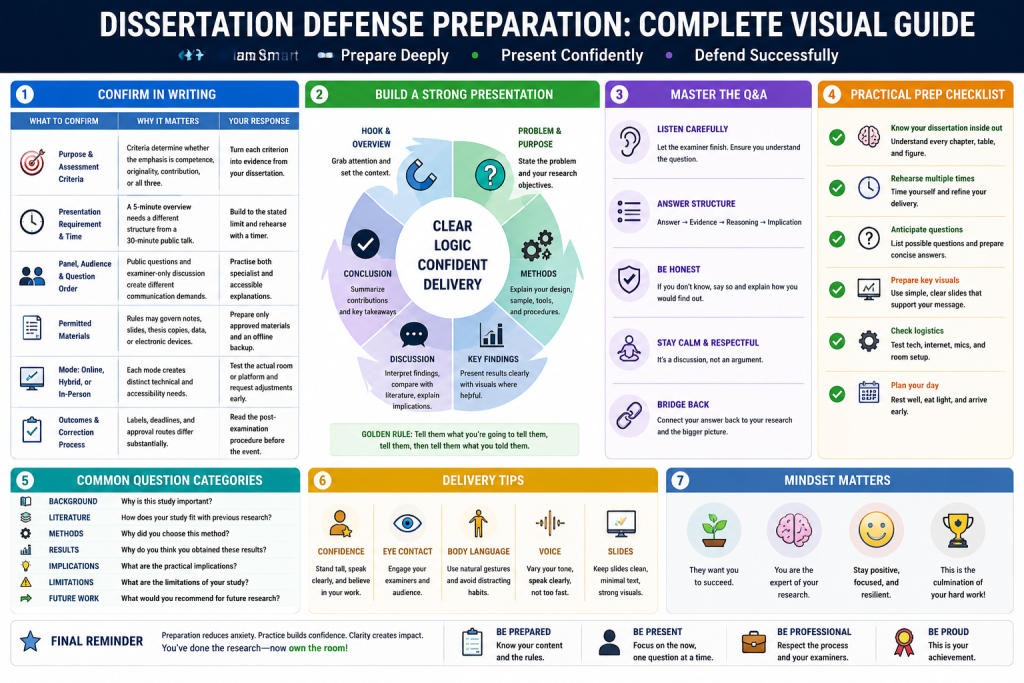
Begin with the official handbook, examination notice, and instructions from your programme. Do not infer your format from another university’s website or a colleague’s experience. At UBC, for example, the final doctoral defense includes a public presentation of up to 30 minutes followed by committee and audience questions. Melbourne describes a usually video-based discussion with two external examiners. UCL notes that its viva format is not fixed and that a presentation may be requested. These are useful examples of variation, not universal rules.
| Confirm in writing | Why it affects preparation | Practical response |
|---|---|---|
| Purpose and assessment criteria | Criteria determine whether the emphasis is competence, originality, contribution, or all three. | Turn each criterion into evidence from your dissertation. |
| Presentation requirement and time | A five-minute overview needs a different structure from a 30-minute public talk. | Build to the stated limit and rehearse with a timer. |
| Panel, audience, and question order | Public questions and examiner-only discussion create different communication demands. | Practise both specialist and accessible explanations. |
| Permitted materials | Rules may govern notes, slides, thesis copies, data, or electronic devices. | Prepare only approved materials and an offline backup. |
| Online, hybrid, or in-person mode | Each mode creates distinct technical and accessibility needs. | Test the actual room or platform and request adjustments early. |
| Outcomes and correction process | Labels, deadlines, and approval routes differ substantially. | Read the post-examination procedure before the event. |
If an instruction is unclear, ask the designated programme administrator or supervisor. Follow local rules about examiner contact; some institutions prohibit candidates from contacting examiners directly before the examination.
Table of Contents
Build a defensible map of your dissertation
A useful defense document is a one-page map linking each central claim to its evidence and boundary. This is more valuable than memorising sentences. Start with the research problem, then connect it to the theoretical framework, research question, design, result, interpretation, and limitation. If one link is weak, prepare an honest explanation of the trade-off.
For each major claim, complete this sentence: “I conclude that ___ because ___; this conclusion is bounded by ___; the next useful test would be ___.” The exercise exposes overclaiming and prepares you to respond directly. It also connects naturally to a careful psychology dissertation discussion and a transparent limitations section.
Know the study at three levels
Prepare a 60-second account for a broad audience, a three-minute overview for an opening question, and a chapter-level explanation for detailed discussion. Each version should state the same core argument at a different resolution. If the versions contradict one another, simplify the central claim until they align.
A sound three-minute overview usually covers the problem, the unresolved gap, the question, the design, the main finding, the contribution, and one important boundary. Do not list every result. Select the evidence required to support the main conclusion.
Create a navigation copy
Use the exact version submitted for examination. Mark the pages containing research questions, hypotheses, conceptual definitions, power or sampling rationale, ethics decisions, primary results, central figures, limitations, and conclusions. Keep a separate error log if you notice typographical or factual corrections. Finding an error is not automatically evidence that the project fails; concealing a material problem is far more damaging than explaining it precisely.
Review your psychology dissertation appendices as well as the main chapters. Examiners may ask about measure wording, coding frameworks, additional analyses, recruitment materials, or participant information that appears there.
Prepare an evidence-led presentation
If a presentation is required, follow the specified duration and audience. A defense presentation is an argument, not a compressed reading of every chapter. Slides should help examiners see the logic connecting the question, method, evidence, and conclusion.
- State the psychological problem and why it matters.
- Define the specific gap without claiming that no research exists unless a systematic search supports that statement.
- Present the research question or hypotheses and the relevant theoretical mechanism.
- Explain the design choices that are necessary to judge the findings.
- Show the primary result with an interpretable figure or concise table.
- Explain the contribution, uncertainty, limitations, and next research step.
Use readable type, high contrast, descriptive slide titles, and colour choices that do not carry meaning alone. Explain axes, units, uncertainty intervals, coding categories, and abbreviations. A statistical chart should reveal the effect and its precision, not merely a significant p value. A qualitative slide should use short, de-identified extracts that illustrate an analytic claim rather than replacing analysis.
Rehearse on the actual equipment when possible. The UBC preparation guidance recommends practice in the room and a platform rehearsal for virtual defenses. Export a PDF copy, keep an approved offline backup, and know how you will continue if slides fail. Never place identifiable participant information on a slide.
Questions to expect in a psychology defense or viva
Examiners’ wording is unpredictable, but the reasoning tasks are not. Questions typically probe significance, theory, design fit, analytic decisions, inference, integrity, and contribution. Use the following map to prepare reasoning rather than scripts.
| Likely question | What it tests | Evidence to prepare |
|---|---|---|
| What is the central contribution? | Ability to distinguish a finding from its significance. | One precise claim, its evidence, and the audience for whom it matters. |
| Why was this theory appropriate? | Conceptual reasoning and awareness of alternatives. | Mechanisms, competing frameworks, and the predictions each would make. |
| Why did this design answer the question? | Alignment between question and method. | Design strengths, feasible alternatives, and the trade-offs rejected. |
| How was the sample justified? | Whether adequacy follows the analytic purpose. | Power or precision reasoning, information needs, inclusion rules, and attrition. |
| Why trust the measure or interpretation? | Validity, reliability, credibility, or reflexive quality. | Evidence appropriate to the construct, population, context, and method. |
| What would change your conclusion? | Calibration and openness to disconfirmation. | Critical assumptions, plausible alternative explanations, and additional data. |
| How were participants protected? | Ethical reasoning beyond approval paperwork. | Consent, risk, privacy, safeguarding, data management, and contextual justice. |
| What would you do differently? | Research maturity rather than confession. | A consequential change, why it matters, and how it improves inference. |
Questions about theory and originality
Be able to separate originality from novelty. A project can contribute by testing a mechanism in a meaningful context, resolving conflicting evidence, improving measurement, integrating methods, or showing that an expected effect is smaller or less general than assumed. Revisit your psychology dissertation theoretical framework and identify where the results support, refine, or challenge its propositions.
For example, a study of academic stress may find that perceived control predicts wellbeing after accounting for workload. A defensible contribution is not “control causes wellbeing” if the design is cross-sectional. It may instead be that the result is consistent with a theoretically expected association and helps prioritise a longitudinal test of temporal ordering.
Questions about quantitative research
Prepare to explain why the statistical model matches the outcome, dependence structure, measurement scale, and research question. Know how missing data were handled, which assumptions matter, how influential observations were assessed, and whether analyses were confirmatory or exploratory. The psychology dissertation data analysis guide provides a broader decision framework.
Answer with estimates and uncertainty where possible. Suppose a confidence interval is compatible with both a small benefit and almost no effect. Say so. Statistical significance does not establish practical importance, causality, measurement validity, or generalisability. If an assumption was imperfect, explain its likely direction of impact and any sensitivity analysis rather than claiming that a diagnostic “passed.”
Questions about qualitative research
Expect discussion of the analytic approach, epistemological position, recruitment, adequacy of the dataset, coding decisions, reflexivity, and the route from data to interpretation. Avoid importing quantitative language automatically. The relevant quality argument may involve coherence, transparency, information power, attention to negative cases, reflexive practice, or another standard justified for the chosen methodology.
For example, in a reflexive thematic analysis of first-generation students’ help-seeking, do not defend a theme only by reporting how many participants mentioned it. Explain the pattern of shared meaning, variation across accounts, interpretive development, and how your position shaped the reading. Show that quotations support the analysis without allowing vivid extracts to stand in for it.
Questions about mixed methods and reviews
For mixed methods, be ready to show where integration occurred and what was learned that neither component could establish alone. A parallel presentation of survey and interview results is not necessarily integration. The APA Journal Article Reporting Standards offer method-specific prompts for transparent reporting across quantitative, qualitative, and mixed-methods studies.
For a systematic, scoping, or meta-analytic dissertation, prepare to justify databases, search limits, screening, appraisal, extraction, synthesis, heterogeneity, and publication-bias decisions. Explain how the review question determines the synthesis. Do not imply that a pooled estimate is automatically more credible than its component evidence.
Use a clear structure for difficult answers
A strong response usually has four moves: answer the question, give the relevant evidence, state the boundary, and explain the implication. This structure keeps you direct without pretending that the evidence is stronger than it is.
| Move | Example response to “Why did you use this measure?” |
|---|---|
| Answer | “I selected it because its construct coverage matched my operational definition of rumination.” |
| Evidence | “Prior studies reported relevant structural and convergent evidence in comparable student samples, and reliability in this dataset was adequate for group-level inference.” |
| Boundary | “However, those data do not establish measurement invariance across every language group represented here.” |
| Implication | “I therefore interpret between-group comparisons cautiously and would test invariance prospectively in a larger multilingual sample.” |
Pause before answering. If a question contains several parts, summarise them and take one at a time. Ask for clarification if a term is ambiguous. It is reasonable to say that you do not know a specific fact, then explain how you would investigate it. It is not reasonable to invent a citation, analysis, or procedure.
When an examiner identifies a real weakness, acknowledge it and assess its consequence. When you disagree, explain the evidence and reasoning courteously. UCL explicitly frames the viva as an academic conversation and advises candidates to defend a justified case while conceding genuine weaknesses. Agreement is not the goal; disciplined reasoning is.
Plan a realistic mock defense
Arrange at least one mock with people who know the field and, if possible, one person outside the narrow topic. Give them the dissertation or a concise brief early enough to prepare. Ask for questions that test reasoning, not encouragement alone. The UK Council for Graduate Education’s candidate guide is another recognised preparation resource.
Run the presentation and questioning under realistic time and technology constraints. Record only if everyone agrees and local policy allows it. Afterward, review whether you answered the actual question, led with a clear claim, used evidence, calibrated certainty, and stopped when the answer was complete.
Convert feedback into a short revision log. Do not script dozens of polished paragraphs. Prepare bullet-point evidence maps and practise varied wording. Over-rehearsed answers can miss the examiner’s question, while flexible retrieval shows genuine command.
A four-week preparation schedule
| Period | Main work | Output |
|---|---|---|
| Four weeks before | Confirm rules, reread the submitted thesis, mark errors, and map claims to evidence. | Requirements checklist, navigation copy, and claim map. |
| Three weeks before | Refresh key and recent literature; review theory, methods, results, ethics, and limitations. | Updated evidence notes and question bank. |
| Two weeks before | Build or refine slides if required; practise concise explanations and difficult questions. | Timed presentation and answer outlines. |
| One week before | Complete a mock defense, repair weak explanations, and test the room or platform. | Final materials, backups, and logistics plan. |
| Day before | Review the one-page map, check materials, and protect sleep and routine. | Ready workspace without last-minute rewriting. |
Adapt this sequence to the time available and your programme’s process. The point is to move from comprehension to retrieval and then to realistic practice, rather than repeatedly rereading without speaking.
Prepare for online, hybrid, and accessible examination
For an online or hybrid defense, test bandwidth, microphone, camera, captions, screen sharing, power, and approved backup communication. Put the thesis and slides on the local device so a cloud failure does not remove access. Close notifications and unrelated documents. Agree in advance what happens if a required participant loses connection.
Accessibility is part of a fair assessment, not an advantage. Consult the designated disability or student-support service early about reasonable adjustments such as breaks, captions, accessible documents, communication pacing, lighting, or physical access. UCL’s candidate guidance signposts reasonable adjustments, while Melbourne encourages closed captions in its video-based viva process. Follow your own institution’s route and deadlines.
For sensitive psychology topics, plan emotional as well as technical support. Do not disclose participant identities in answers or slides. If an examiner asks for a detail that would breach consent or confidentiality, explain the ethical boundary and provide an appropriately aggregated or de-identified answer. Review the principles in your psychology dissertation ethics documentation.
On the day of the defense
Arrive or log in early enough to test the environment without rushing. Bring the permitted thesis copy, page-matched notes, presentation backups, water, and any approved accessibility equipment. During the examination, listen to the entire question and note its key terms. A brief pause is better than an immediate answer to a question you have misheard.
Keep the distinction between observation and interpretation visible. Refer to the relevant table, model, extract, or page when helpful. If your results section reports several secondary analyses, identify which were planned and which were exploratory. Do not upgrade exploratory patterns during the oral discussion.
Length is not a reliable signal of outcome. Institutional formats alone show substantial variation: UBC describes a public defense that usually takes two to two and a half hours, while Melbourne describes a viva typically lasting one to two hours. Interpret the event through your official criteria, not the clock or an examiner’s facial expression.
After the examination: outcomes and corrections
Outcome labels range from pass with no changes to minor corrections, substantial revisions, re-examination, or fail, but terminology and authority differ. Wait for the formal written outcome. Compare it with your notes, clarify ambiguities through the authorised channel, and create a correction table containing each requested change, its location, your response, and the evidence that it has been completed.
Do not make unrequested conceptual changes that create new inconsistencies. When a requested revision cannot be followed literally, explain the issue and propose an evidence-based resolution through the correct process. Keep versions, dates, and approvals. The UBC Final Oral Defence guidance illustrates how revision categories and approval routes can be embedded in local evaluation procedures.
Frequently asked questions
How long should I prepare for a psychology dissertation defense?
There is no universal period. If possible, allow several weeks for rereading, evidence mapping, literature updates, speaking practice, and a mock examination. Start earlier if a formal presentation, accessibility arrangement, or complex technical setup is required.
Should I memorise my dissertation?
No. Know its argument, evidence, decisions, and page structure. Memorising prose can make answers rigid. A navigable submitted copy, a claim map, and repeated practice retrieving the reasoning are more useful.
What if I find an error before the viva?
Record the exact location, classify its importance, work out whether it changes any result or conclusion, and follow local guidance on when to disclose it. Be ready to explain the correction transparently. Never quietly substitute a new thesis version unless authorised.
Can I say “I don’t know”?
Yes, when accurate. State what you know, define the uncertainty, and explain how you would find or test the answer. Do not bluff. Examiners are assessing judgement as well as recall.
How many slides should a defense presentation contain?
Use the number needed to communicate the core argument within the assigned time and accessibility requirements. A slide-per-minute rule is unreliable. Rehearse the actual talk, remove nonessential detail, and leave time for transitions and questions.
What is the best way to answer a critical examiner?
Answer the specific criticism, cite the relevant evidence, acknowledge real limits, and explain the consequence for the conclusion. Defend a justified decision calmly, but do not treat every challenge as something you must defeat.
Conclusion
A strong psychology dissertation defense shows ownership of the reasoning, not perfection. Confirm the local format, map claims to evidence and limits, practise explaining the study at several levels, and rehearse difficult questions in realistic conditions. During the examination, answer directly, calibrate certainty, protect participant confidentiality, and treat criticism as part of scholarly evaluation.
If you want ethical support refining your preparation, Psychology Dissertation Help can help you review argument clarity, presentation structure, and practice questions without impersonating you, fabricating evidence, or replacing the independent judgement your examination is designed to assess.