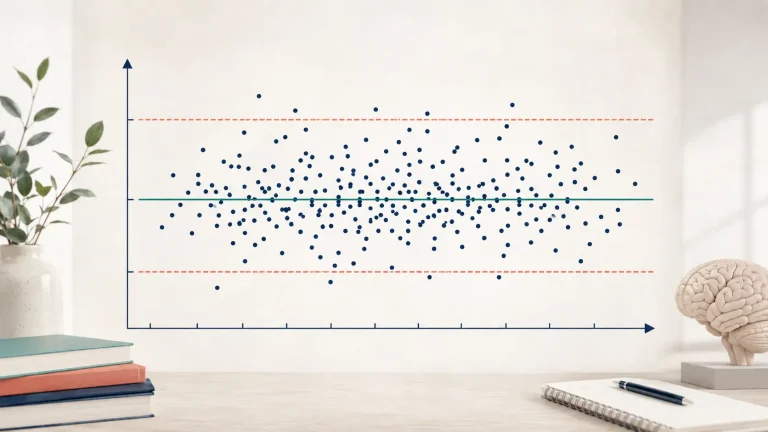
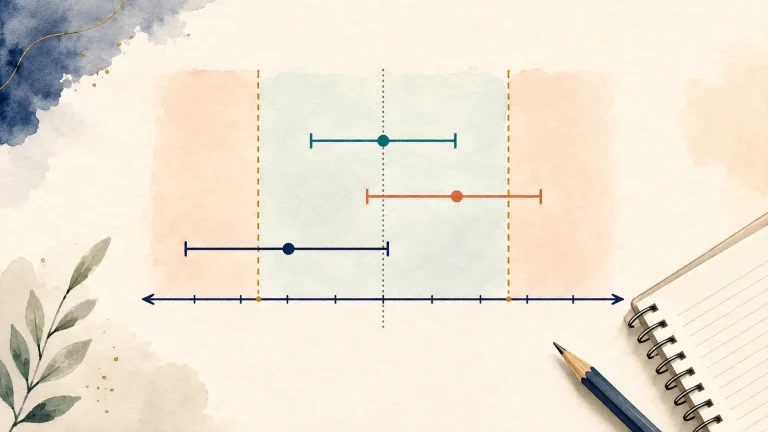
Psychology dissertation dynamic SEM connects time-series analysis, multilevel modelling, and structural equation modelling to study intensive repeated measurements. It can separate stable differences between people from short-term processes within people while allowing lagged effects, random parameters, and latent variables.
DSEM is powerful but demanding. Closely spaced observations are not ordinary independent rows, lagged coefficients are not automatically causal, and software output does not repair a poorly timed design. This guide explains how to plan, estimate, check, interpret, and report a defensible dissertation analysis.
What is dynamic structural equation modelling?
Dynamic structural equation modelling, usually shortened to DSEM, is a framework for intensive longitudinal data. These data contain many repeated observations from each person, dyad, or other unit. Examples include ecological momentary assessments, experience-sampling prompts, daily diary responses, wearable measures, and repeated behavioural observations.
DSEM combines three traditions. Time-series models represent serial dependence and lagged relations. Multilevel models distinguish observations within people from differences between people. Structural equation models add path structures, latent variables, measurement models, and relations among random effects.
The foundational article by Asparouhov, Hamaker, and Muthén describes DSEM as a framework for the evolution of observed and latent variables in intensive longitudinal data. The Utrecht University research record for Dynamic Structural Equation Models verifies the article, authors, journal, pages, and DOI.
DSEM is not simply conventional structural equation modelling with many rows. The time ordering, nested structure, person-specific means, serial dependence, and unequal observation patterns must be represented explicitly.
When does DSEM fit a psychology dissertation?
Use DSEM when the research question concerns processes unfolding within people over many occasions and when individual differences in those processes matter. A study might ask whether higher-than-usual worry predicts sleep difficulty at the next assessment, whether negative affect persists from one occasion to the next, or whether autoregressive persistence differs by baseline depression.
DSEM is unnecessary when there are only two or three widely spaced waves and the question concerns change across those waves. A cross-lagged panel model, growth model, or conventional multilevel model may be better. It is also unsuitable when measurements are not meaningfully ordered or the interval is unrelated to the process.
The official Mplus time-series and DSEM resource page describes applications to ecological momentary assessment, experience sampling, diary, and ambulatory data. It also explains that time points are typically nested within individuals and that individual differences in means, variances, and autocorrelations can be modelled as random effects.
Start with a within-person question
“Do anxious people sleep less?” is a between-person question. “When a person is more anxious than usual, do they sleep less afterward?” is a within-person question. These can have different answers. Write the level of inference into the research aim before selecting variables or lags.
Understand the main DSEM components
| Component | What it represents | Psychology example |
|---|---|---|
| Person-specific mean | A participant’s expected level across occasions | Usual negative affect |
| Autoregressive effect | Persistence of a variable from one occasion to the next | Current worry predicted by previous worry |
| Cross-lagged effect | One variable predicting another at a later occasion | Earlier stress predicting later avoidance |
| Contemporaneous relation | Same-occasion residual association after modelled lags | Unexpected stress co-occurring with low mood |
| Random effect | Variation in a parameter across people | Individuals differing in worry persistence |
| Between-person predictor | A stable characteristic explaining person-level differences | Trait anxiety predicting average reactivity |
Each component answers a different question. An autoregressive coefficient is not a general measure of importance. A cross-lagged path is conditional on included variables, lag length, centring, trends, measurement quality, and model assumptions. A contemporaneous association has no temporal direction within the measurement occasion.
Design the measurement schedule around the process
The lag is created by the observation schedule. If prompts occur every three hours, a lag-one effect concerns approximately three hours only when spacing is regular. If a study asks once per day, the same lag index represents roughly one day. Neither estimate automatically generalises to minutes, weeks, or months.
Choose frequency using substantive theory, prior studies, participant burden, and the expected speed of change. Affect may shift within hours, while another construct may develop over days. Sampling too slowly can miss short processes. Sampling too frequently can create reactivity, fatigue, low compliance, and repeated responses with little meaningful change.
Define the observation window, prompt schedule, overnight gaps, weekends, time zones, allowed response delay, and minimum completion rule. Explain how unequally spaced observations will be handled. Do not treat the final prompt on one day and first prompt the next morning as equivalent to two prompts separated by an hour unless the model represents that difference.
Use the site’s ecological momentary assessment guide to plan prompts, burden, compliance, and privacy before finalising the analysis.
Separate within-person and between-person variation
Suppose participants with higher average stress also report higher average low mood. That between-person relation does not show that a person becomes lower in mood whenever their stress rises above their own norm. DSEM can distinguish these levels by decomposing a time-varying predictor into a person-specific mean and within-person deviations.
Centring is therefore substantive, not cosmetic. Observed person-mean centring uses each participant’s sample mean as if known without error. Latent-mean approaches estimate person means within the model and can account for uncertainty, subject to assumptions and priors. State exactly how each time-varying predictor was centred.
Do not mix raw, grand-mean-centred, and person-centred predictors without explaining the resulting coefficients. A predictor’s within-person and between-person effects can differ in magnitude or direction. Interpret each at its correct level.
Choose variables and measurement models carefully
Repeated single items reduce burden but can have limited reliability and content coverage. Multi-item measures offer richer measurement but may be impractical at every prompt. Use measures validated for the intended time frame and level. A scale designed for symptoms during the past month may not capture momentary fluctuation.
DSEM can include latent variables, but dynamic factor models increase complexity. Consider whether measurement parameters are stable across time and people, whether enough indicators are available, and whether the data identify the intended model. Avoid building a large latent dynamic model merely because the software permits it.
Binary and ordinal outcomes need suitable links and distributional assumptions. Continuous approximations for sparse binary events can be misleading. The model should match the variable type, the scientific question, and the amount of information available at each level.
Specify dynamics that theory can defend
An autoregressive order of one assumes the immediately preceding observation captures the relevant direct history after other predictors are included. Higher-order lags can represent longer memory but require more information and complicate interpretation. Choose lags using theory, timing, diagnostics, and prespecified sensitivity analyses.
For two variables, a simple model might include both autoregressive paths, two cross-lagged paths, and contemporaneous residual association. Adding random slopes allows these paths to vary across participants. Between-person variables can then predict those random parameters.
The supporting materials maintained by methodologist Ellen Hamaker explain DSEM as a combination of time-series, multilevel, and SEM traditions. The open DSEM book-chapter resource includes model descriptions and detailed analysis inputs.
Trends, cycles, and stationarity
Many dynamic models assume a process is stable enough that parameters have consistent meaning during the study. Learning, treatment, fatigue, weekday cycles, and gradual trends can violate that simplification. Plot individual trajectories and time-of-day patterns before estimation.
Represent important deterministic trends when justified. Consider linear or nonlinear time, study day, weekday, or cyclical effects. Detrending can also remove meaningful psychological change, so every adjustment needs a substantive reason. Report sensitivity to plausible trend specifications.
Plan sample size at both levels
DSEM has two relevant dimensions: the number of people and the number of observations per person. More people usually improve estimation of between-person variation and predictors. More occasions improve information about within-person dynamics. The balance needed depends on effect sizes, reliability, missingness, lag structure, random effects, priors, and model complexity.
There is no universal minimum number of prompts or participants. A model may run while random-slope estimates remain weakly identified or highly prior-sensitive. Plan through simulation that mirrors the intended schedule, compliance, variable distributions, and parameter values. Evaluate bias, coverage, convergence, interval width, and power for the primary parameters.
Document these decisions in a psychology dissertation power analysis. If sample size is fixed, conduct a precision or simulation-based feasibility assessment instead of claiming retrospective power validates the study.
Use Bayesian estimation responsibly
Many DSEM implementations use Bayesian estimation because the model contains numerous random parameters and latent quantities. Bayesian estimation requires choices about priors, chains, iterations, burn-in, thinning where applicable, and convergence assessment. Defaults are not a substitute for justification.
Choose priors that respect the scale and plausible parameter range. Highly diffuse priors can behave poorly in complex hierarchical models, while overly concentrated priors can dominate sparse data. Run prior predictive checks or at least inspect what the priors imply. Report sensitivity to reasonable alternative priors for important or weakly informed parameters.
Assess convergence using multiple chains, trace plots, potential scale-reduction diagnostics, effective sample sizes, and warnings. A single convergence number cannot show that the model is correct. Inspect posterior distributions, parameter correlations, and whether estimates are near boundaries.
Handle missing and irregular observations
Intensive studies commonly contain missed prompts, delayed responses, device failures, and planned overnight gaps. Describe missingness by person, day, prompt position, and study time. Examine whether compliance relates to earlier outcomes or participant characteristics.
Likelihood-based or Bayesian estimation can use incomplete outcome records under stated assumptions, but it does not make nonresponse harmless. If distress predicts missed prompts, missingness may be informative. Include relevant predictors of missingness where appropriate and conduct sensitivity analyses for plausible departures.
Decide how lagged variables cross gaps. A lag-one relationship across a long missing interval may not represent the same process as adjacent observations. Use time indicators, reset rules, or continuous-time approaches when justified. Follow the site’s missing-data planning guide.
Check model fit, diagnostics, and robustness
No single diagnostic proves a DSEM is adequate. Begin with descriptive plots for each participant, response distributions, missingness, autocorrelations, and trends. After estimation, examine convergence, posterior predictive checks where available, residual patterns, extreme random effects, and sensitivity to priors and lags.
| Check | Problem it can reveal | Possible response |
|---|---|---|
| Individual time plots | Trends, cycles, errors, restricted variation | Correct verified errors and model justified time structure |
| Autocorrelation plots | Unmodelled serial dependence | Compare defensible lag structures |
| Chain trace plots | Poor mixing or non-convergence | Reparameterise, strengthen justified priors, or simplify |
| Posterior predictive checks | Model cannot reproduce relevant data features | Revise the model with substantive justification |
| Prior sensitivity | Important estimates driven by assumptions | Report fragility and collect more information |
| Person-level estimates | Outlying or weakly informed random effects | Investigate data quality and model assumptions |
Compare models only when they target the same question and use suitable criteria. A more complex model is not automatically better. Avoid adding paths until fit improves, because that creates an exploratory search that standard errors and posterior intervals do not acknowledge.
Interpret coefficients at the correct level
An autoregressive coefficient describes persistence conditional on the model. A positive value means a deviation tends to carry forward to the next modelled occasion. It does not mean the construct causes itself or that a participant is clinically inflexible.
A cross-lagged coefficient indicates whether one prior deviation predicts another later deviation after included lagged variables and covariates. It does not establish causal direction. Unmeasured time-varying confounding, contemporaneous effects, measurement error, schedule choice, and feedback can affect the estimate.
Random-effect variance indicates heterogeneity beyond estimated uncertainty under the model. If a between-person variable predicts a random slope, describe it as explaining variation in an estimated dynamic parameter, not proving why individuals differ.
| Risky wording | Defensible wording |
|---|---|
| Stress caused low mood three hours later. | Higher-than-usual stress predicted higher low mood at the next scheduled assessment. |
| People with depression have stronger emotional inertia. | Baseline depression was associated with the estimated person-specific autoregressive effect. |
| The cross-lag proved direction. | The temporal association was conditional on the specified lag, variables, and assumptions. |
| No path means no process exists. | The posterior estimate was imprecise or concentrated near zero under this model. |
Worked psychology example
Consider a dissertation in which 160 students report stress, rumination, and negative affect five times per day for 21 days. The main question asks whether above-usual stress predicts later negative affect directly and indirectly through later rumination. Trait anxiety is proposed as a predictor of person-to-person differences in these dynamics.
The schedule uses semi-random prompts within fixed windows. Lags reset overnight because the gap differs substantially from daytime spacing. Momentary variables are decomposed into within-person deviations and person-level means. The model includes autoregressive paths, theoretically selected cross-lagged paths, and random slopes for the primary effects.
The student simulates the design before collection, preregisters primary paths and prior distributions, and records response timing. Diagnostics show a daily trend in stress, so a prespecified time-of-day term is retained. The posterior interval for stress predicting later rumination excludes effects near zero, while the rumination-to-affect path is wide and prior-sensitive.
The discussion reports conditional temporal associations, not a confirmed mediation mechanism. It notes self-report measurement, variable spacing within windows, incomplete prompts, limited study duration, and residual time-varying confounding. Code, synthetic data, priors, diagnostics, and sensitivity results accompany the dissertation.
A reproducible DSEM workflow
- Define the process. State the within-person estimand, time scale, population, and primary paths.
- Design sampling. Align frequency and duration with theory while limiting burden.
- Audit measurement. Confirm response scales, timing, reliability, and within-person variation.
- Plan information. Simulate participants, occasions, missingness, and model complexity.
- Prepare transparently. Document lags, gaps, centring, trends, exclusions, and missing-data rules.
- Estimate reproducibly. Save code, versions, seeds, priors, chains, and warnings.
- Diagnose. Check convergence, posterior behaviour, residual patterns, fit, and sensitivity.
- Interpret cautiously. Separate within-person, between-person, contemporaneous, and lagged conclusions.
What to report in the dissertation
Report recruitment, participant count, planned and completed observations, compliance distribution, timing, spacing, overnight treatment, measures, scoring, missingness, and exclusions. Specify all within-person and between-person equations or provide a path diagram with unambiguous labels.
Document centring, lag order, trends, random effects, variable distributions, software and version, estimator, priors, chains, iterations, convergence criteria, and model-comparison decisions. Present posterior estimates with credible intervals and meaningful units. Include diagnostic figures and prespecified sensitivity analyses.
Protect privacy. Intensive data can reveal routines, location patterns, health events, and relationships even after names are removed. Share de-identified data only when consent and governance permit. Otherwise provide synthetic data, code, metadata, and a controlled-access process.
Common mistakes to avoid
- Treating intensive observations as independent cases.
- Interpreting between-person associations as within-person processes.
- Choosing the sampling interval for convenience without a process theory.
- Carrying lagged predictors across long or irregular gaps without justification.
- Using raw time-varying predictors without explaining centring.
- Adding many random slopes or latent variables that the design cannot support.
- Reporting Bayesian output without priors, chain diagnostics, or sensitivity checks.
- Calling a cross-lagged coefficient causal or a contemporaneous edge directional.
Frequently asked questions
How many observations per person does DSEM need?
There is no universal minimum. Requirements depend on participants, occasions, effect sizes, missingness, reliability, lag order, random effects, and priors. Simulate the exact proposed design.
Is DSEM only for ecological momentary assessment?
No. It can analyse experience-sampling, diary, ambulatory, wearable, observational, dyadic, and other intensive ordered measurements when the model matches the data.
How is DSEM different from a cross-lagged panel model?
DSEM usually targets many closely spaced observations and combines time-series and multilevel structures, often with random dynamic parameters. Traditional panel models typically use fewer, widely spaced waves.
Does a lagged effect prove causation?
No. Time order helps define the association but does not remove unmeasured confounding, measurement error, feedback, or dependence on the chosen interval and model.
Must DSEM use Bayesian estimation?
Not conceptually, but prominent implementations use Bayesian methods for complex hierarchical dynamic models. Report the estimator and all assumptions rather than treating software defaults as universal.
Can DSEM include categorical variables?
Yes, in implementations that support suitable models for binary or ordinal outcomes. Sparse categories, link functions, computational demands, and interpretation require specific attention.
What should I share for reproducibility?
Share code, model syntax, priors, software versions, decision rules, diagnostics, and a data dictionary. Use synthetic or controlled data when participant confidentiality prevents open sharing.
Conclusion
Psychology dissertation dynamic structural equation modelling is most valuable when the design captures a process at a meaningful time scale. Separate within-person change from between-person difference, model serial dependence, plan both sample dimensions, examine priors and diagnostics, and interpret lagged paths as conditional temporal associations.
If you need dissertation support, choose ethical guidance that helps you understand and defend your own design, code, and conclusions. Retain responsibility for every decision, protect intensive participant data, follow institutional rules, and acknowledge permitted assistance transparently.