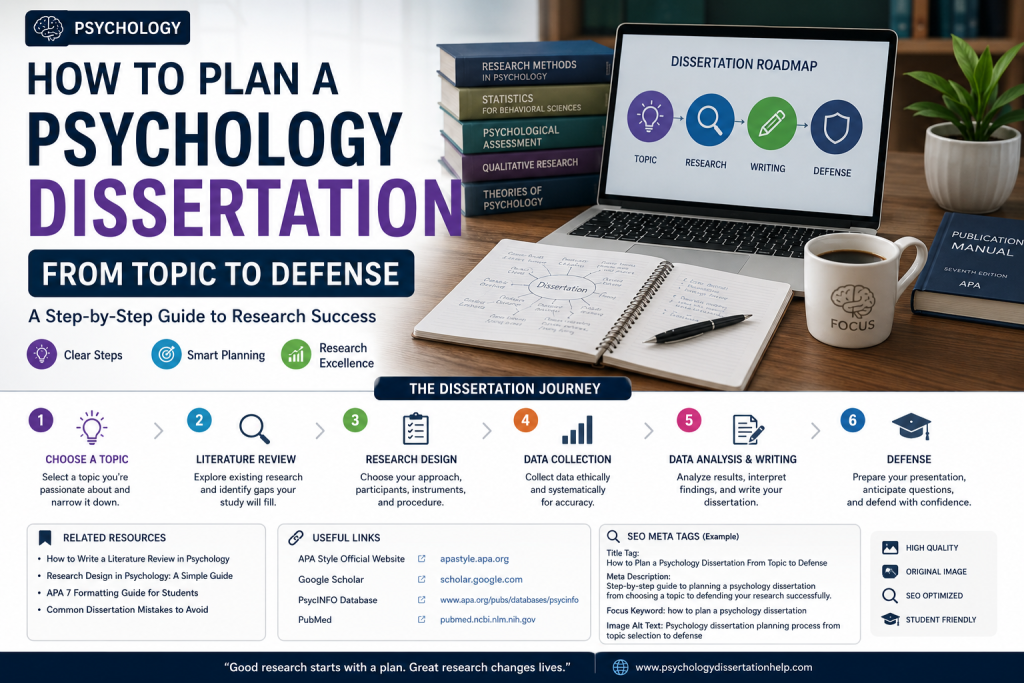
How to Plan a Psychology Dissertation: A Complete Guide from Topic Selection to Defense
Meta Title
How to Plan a Psychology Dissertation: A Step-by-Step Guide (2026)
Meta Description
Learn how to plan a psychology dissertation from choosing a research topic to defending your research. This step-by-step guide helps undergraduate, master’s, and PhD students complete a successful dissertation.
Focus Keyword
How to Plan a Psychology Dissertation
URL Slug
how-to-plan-a-psychology-dissertation
How to Plan a Psychology Dissertation: A Complete Guide from Topic Selection to Defense
Planning a psychology dissertation is one of the most important steps toward completing your degree successfully. Whether you’re an undergraduate, master’s, or PhD student, a well-planned dissertation helps you stay organised, manage your time effectively, and produce high-quality research.
Many students struggle because they choose broad topics, delay their literature review, or underestimate the time needed for research and writing. Fortunately, these challenges can be avoided with a clear plan.
This guide explains how to plan a psychology dissertation from selecting a research topic to defending your final research. You’ll learn practical strategies to help you complete each stage with confidence.
Table of Contents
- What Is a Psychology Dissertation?
- Why Planning Matters
- Step 1: Choose a Research Topic
- Step 2: Conduct a Literature Review
- Step 3: Develop a Research Question
- Step 4: Select Your Research Methodology
- Step 5: Obtain Ethical Approval
- Step 6: Collect Data
- Step 7: Analyse Your Findings
- Step 8: Write Your Dissertation
- Step 9: Edit and Proofread
- Step 10: Prepare for Your Dissertation Defense
- Common Mistakes to Avoid
- Frequently Asked Questions
What Is a Psychology Dissertation?
A psychology dissertation is an independent research project that demonstrates your ability to investigate a psychological topic using recognised research methods. It requires you to identify a research problem, review existing literature, collect and analyse data, and present your findings in a clear, academic format.
Depending on your level of study, your dissertation may involve surveys, interviews, experiments, case studies, or secondary data analysis. Regardless of the method used, careful planning is essential for producing a well-structured and academically sound dissertation.
Why Planning Matters
Planning provides a clear roadmap for your dissertation and helps keep your research focused from beginning to end. Without a plan, it’s easy to miss deadlines, collect unsuitable data, or lose direction during the writing process.
Effective planning helps you:
- Stay organised throughout your research
- Manage your time efficiently
- Meet university deadlines
- Produce higher-quality work
- Reduce stress and last-minute revisions
Starting with a clear plan makes the entire dissertation process more manageable and increases your chances of academic success.
Step 1: Choose a Research Topic
Choosing the right topic is the foundation of a successful psychology dissertation. Your topic should be interesting, relevant, and manageable within your available time and resources.
A strong dissertation topic should be:
- Relevant to current psychology research
- Supported by sufficient academic literature
- Specific and focused
- Ethical and feasible to investigate
- Interesting to you and your supervisor
Popular Psychology Dissertation Areas
- Clinical Psychology
- Cognitive Psychology
- Developmental Psychology
- Educational Psychology
- Health Psychology
- Social Psychology
- Forensic Psychology
- Neuropsychology
- Organisational Psychology
- Sports Psychology
When choosing your topic, look for gaps in existing research where your study can contribute new insights.
Example
Instead of asking:
“Does stress affect students?”
Consider a more focused research question:
“How does academic stress influence sleep quality among undergraduate psychology students?”
A specific topic makes it easier to conduct meaningful research and produce a focused dissertation
https://www.waldenu.edu/programs/psychology/best-practices-as-you-begin-your-psychology-dissertation