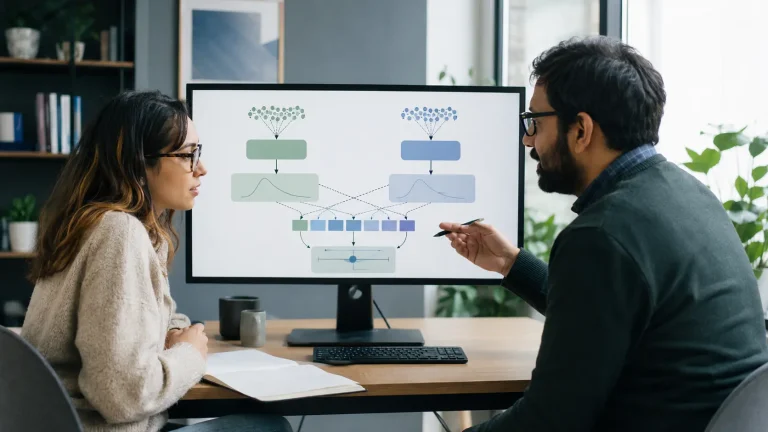
Psychology dissertation Tobit regression is appropriate when a continuous outcome is genuinely censored at a known lower or upper limit. This guide explains how censoring differs from ordinary floor effects, truncation and excess zeros; how the latent-variable model works; which assumptions and diagnostics matter; and how to report marginal effects without confusing an unobserved latent outcome with the recorded score.
What is Psychology dissertation Tobit regression models
Tobit regression, also called censored normal regression, assumes an underlying continuous latent outcome that follows a linear regression model. The outcome is observed exactly within a defined range, but values beyond a censoring limit are recorded at that limit. The likelihood uses both the exact uncensored values and the probability that censored observations fall beyond the boundary.
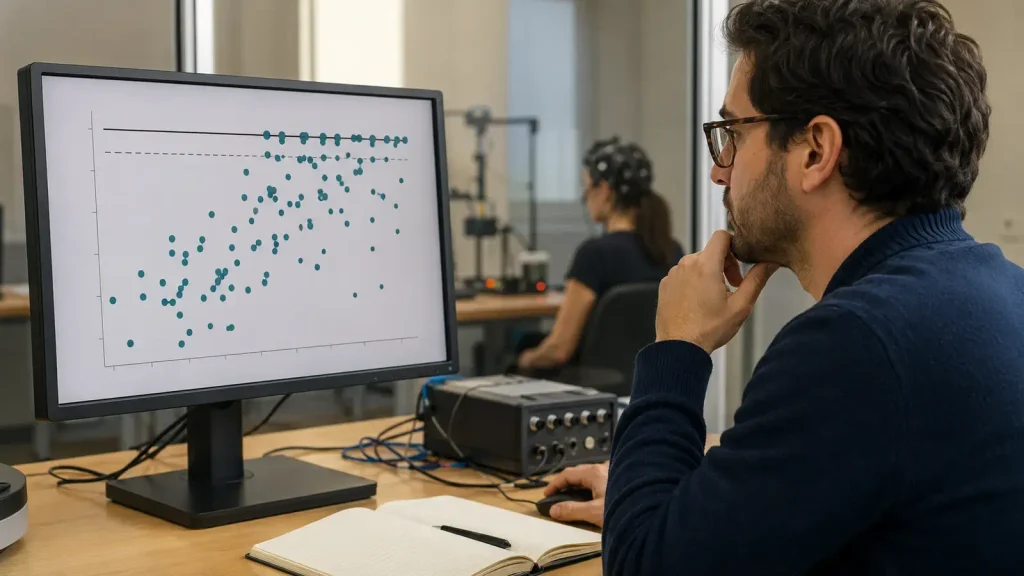
The model is associated with James Tobin’s work on limited dependent variables. The Cowles Foundation record of Tobin’s paper identifies the discussion paper and its later 1958 publication in Econometrica. Modern software can fit left-censored, right-censored and two-limit models.
Suppose a computerised attention task records response latency only up to 3,000 milliseconds. A participant who takes longer is recorded as 3,000, although the true latency could be higher. This is right-censoring. A biochemical stress marker reported as “below 0.2” is left-censored because the precise value below the detection limit is unknown. A pile-up at a boundary is not enough. The dissertation must establish that observations at the limit conceal values that would otherwise extend beyond it. If zero means the true absence of an event, or a maximum scale score is the construct’s actual endpoint, a classical Tobit interpretation may be indefensible.
Analysis of scores and excess zeros in a psychology dissertation
| Data feature | What is observed | Possible approach | Critical distinction |
|---|---|---|---|
| Censoring | All cases remain, but some outcomes are known only to be beyond a limit | Tobit or another censored-outcome model | The hidden value could cross the recorded boundary |
| Truncation | Cases outside a range are absent from the sample | Truncated regression or selection-aware model | Missing cases, not merely hidden values |
| Bounded scale | Scores cannot exceed instrument endpoints by definition | Ordinal, beta-type, item-level or other measurement model | No guaranteed latent normal value beyond the endpoint |
| True zeros plus positive values | Zero is a real state; positives are continuous or counts | Two-part, hurdle or count model | Zero may reflect a separate process |
| Missing outcome | No usable measurement is recorded | Missing-data method | Missing is not a censored value unless a bound is known |
The UCLA Statistical Methods Tobit guide distinguishes censoring from truncation: censored observations remain in the dataset although their precise values are unknown, while truncation excludes observations because of their values. Choosing the wrong model changes the population represented by the likelihood.
Table of Contents
Floor and ceiling effects need investigation
A questionnaire may show many minimum or maximum scores because items are too easy, too difficult or poorly targeted. This is a measurement problem, not automatically censoring. Classical Tobit assumes a meaningful continuous latent response beyond the recorded limit and a common linear model for both boundary membership and uncensored magnitude.
Review the instrument’s scoring rules, item content and intended interpretation. If the endpoint is intrinsic to the construct scale, consider ordinal modelling, item response theory, beta regression after a justified transformation, or redesign. A Tobit model should not be used simply to make a skewed bounded score look convenient.
Excess zeros are not automatically left-censoring
Zero counselling sessions, panic episodes or alcohol-use days may be genuine counts. A negative latent count is usually not scientifically meaningful, so a zero-censored normal model can impose an implausible mechanism. Count, hurdle or mixture models may fit the event-generating process better. Compare the zero-inflated regression guide before treating zeros as censored continuous values.
Plan a psychology dissertation Tobit regression
Begin with the observation process. State the outcome, unit, instrument, lower and upper limits, and exactly why the true value is hidden at each limit. Document whether limits are fixed for everyone or vary by participant, device, site or wave. Variable detection limits require software that accepts observation-specific bounds.
Define the target of inference. Do you want an association with the latent uncensored outcome, the expected recorded outcome, the probability of being censored, or the conditional mean among uncensored observations? These are different estimands even when derived from the same fitted model.
Map every recorded boundary value
Create explicit censoring indicators from documented rules rather than guessing from the sample minimum or maximum. A value equal to the limit can sometimes be observed exactly and sometimes be censored. If the dataset cannot distinguish these cases, explain the ambiguity and run sensitivity analyses under plausible coding decisions.
Check unit conversions, rounding and top coding. A value rounded to 100 is not necessarily right-censored at 100. Similarly, “less than 5” communicates an interval, whereas entering every such observation as exactly 5 discards the censoring information.
Choose covariates from a causal and measurement rationale
Use theory and a temporal model to select predictors and adjustment variables. Do not add covariates because they reduce the censoring percentage or improve significance. Consider whether a predictor affects the outcome, the measurement limit, study inclusion or missingness. The confounding variables guide helps separate confounders from mediators and colliders.
Understand the classical Tobit assumptions in Psychology dissertation
The standard Tobit model assumes a latent outcome that is linear in predictors with normally distributed, independent and homoscedastic errors. Censoring occurs at known limits, and the same coefficient vector governs both whether the latent value crosses the limit and its level when observed. Maximum-likelihood estimates can be sensitive when these assumptions fail.
Latent linearity
Continuous predictors should have an appropriate functional form on the latent scale. Plot uncensored observations and use subject knowledge to consider transformations, splines or prespecified nonlinear terms. A classical Tobit coefficient is not reliable merely because the observed uncensored section looks roughly linear.
Normality and constant variance
Normal latent errors and constant residual variance are central to the usual likelihood. Skewness or variance that changes with predictors can alter the estimated probability mass at the censoring point and the slope. Examine uncensored residuals cautiously, compare predicted and observed distributions, and fit defensible heteroscedastic or alternative-distribution models when supported.
One-process restriction
The classical model links boundary probability and outcome magnitude through one latent regression. This can be too restrictive when reaching the boundary and varying within the uncensored range arise from different psychological or access processes. A two-part model may be more interpretable if theory supports separate mechanisms.
Choose left, right or two-limit censoring
Left-censoring means the true outcome is at or below a lower limit. Right-censoring means it is at or above an upper limit. Two-limit Tobit models permit both. The model specification must match the observation protocol rather than the observed histogram alone.
Stata’s official censored-outcome documentation describes Tobit models with fixed left or right limits and interval-regression methods when observations are recorded as ranges or limits vary. Confirm the precise capability and parameterisation of the software version used.
| Psychology example | Observation rule | Censoring type |
|---|---|---|
| Reaction-time task timeout | All values above 3,000 ms recorded as 3,000 | Right |
| Hormone assay detection limit | All values below 0.2 recorded at or below 0.2 | Left |
| Device measurement range | Values below 1 and above 100 not measured precisely | Two-limit |
| Questionnaire maximum | Maximum is a defined sum-score endpoint | Not automatically censoring |
Plan sample size and power by simulation
Information depends on total sample size, censoring proportion, predictor distribution, effect size, residual variance, number of covariates, clustering and whether censoring occurs on one or both sides. A nominally large sample with very few uncensored observations can estimate the latent slope and variance poorly.
Simulate data from plausible latent distributions, apply the exact censoring mechanism, fit the planned model and assess convergence, bias, confidence-interval coverage, power and marginal-effect precision. Include heteroscedastic, skewed and misspecified scenarios. The power analysis guide explains why design-specific simulation is stronger than a universal participants-per-predictor rule.
Fit and document the model of your psychology dissertation
Report the software, package, version, likelihood, censoring limits, optimisation method, convergence criteria, variance estimator, weights, clustering and missing-data rules. Save syntax and a data dictionary. The analysis should be reproducible without relying on screenshots of output.
Verify how the program defines left and right censoring, especially when observations equal the boundary. Check whether limits can vary by observation and whether robust, clustered or multilevel options change the estimand or assumptions.
Check numerical convergence
Inspect optimiser messages, iteration history, gradients, Hessian behaviour, standard errors and parameter magnitudes. Refit from alternative reasonable starting values when supported. Very large standard errors, boundary variance estimates or sensitivity to starting values suggest weak information or model misspecification.
Account for repeated measures and clusters
Observations may be nested within participants, therapists, laboratories or schools. Ordinary Tobit standard errors assume independence. Use a multilevel or cluster-aware censored model when the design requires it and the sample supports the additional parameters.
Stata’s official multilevel Tobit overview describes random intercepts, random coefficients and observation-specific limits. It also distinguishes inference for the latent uncensored outcome from inference for the censored observed outcome. See the multilevel modelling guide for broader nesting decisions.
Diagnose model fit and influential observations
No single residual plot validates a Tobit model. Compare observed and predicted proportions at each limit, the distribution of uncensored values, conditional means across predictors and tail behaviour. Plot residuals for uncensored observations while recognising that they are a selected subset of the latent distribution.
Use probability-scale, quantile or simulation-based residuals when supported. Compare replicated datasets with the observed histogram and boundary masses. A model can match the mean yet badly miss the censoring probability or uncensored variance.
Check heteroscedasticity and non-normality
Plot residual spread across fitted values and important predictors. Compare a classical model with a prespecified heteroscedastic or robust alternative. If conclusions change, report the sensitivity rather than selecting whichever model gives the preferred p-value.
Check influence
A few uncensored extreme values can strongly determine the latent slope because censored observations contribute only partial ordering information. Verify records, examine case-deletion or influence measures, and retain valid observations in the primary analysis unless a prespecified rule applies. The outlier analysis guide provides a transparent framework.
Interpret coefficients and marginal effects correctly
Raw Tobit coefficients describe the expected change in the latent uncensored outcome for a one-unit predictor change, conditional on covariates. They are not generally the change in the expected recorded outcome, the probability of being uncensored or the mean among uncensored observations.
Compute quantities that match the research question. Useful outputs include predicted censoring probability, expected observed outcome, expected latent outcome and expected value conditional on being uncensored. Report the prediction definition, covariate values, units and confidence intervals.
Psychology-specific example
Consider an inhibitory-control task that ends trials at 2,500 milliseconds. The outcome is response latency, with timeouts recorded at 2,500. A Tobit model relates latent latency to sleep deprivation, age and task condition while recognising that timeout values are only lower bounds on true latency.
A positive sleep-deprivation coefficient indicates higher expected latent latency under the model. To communicate practical impact, report predicted timeout probability and expected recorded latency at meaningful sleep values. Do not describe participants with timeouts as sharing the same true response speed.
Compare plausible alternative models in psychology dissertation
Fit alternatives that correspond to different observation mechanisms, not a random catalogue of tests. Ordinary linear regression treats boundary values as exact. Truncated regression assumes excluded cases. Quantile regression targets conditional quantiles and may be useful for distributional questions, but standard versions do not automatically reconstruct censored values. Survival-style models can handle time censoring but answer different questions.
The quantile regression guide explains conditional quantiles, while the survival analysis guide covers time-to-event censoring. Compare predicted boundary mass, uncensored distribution, calibration, convergence and substantive interpretability. A lower information criterion does not repair an implausible censoring story.
Handle missing data separately
A censored outcome provides a bound; a missing outcome may provide no value information. Do not recode nonresponse as the lower limit. Describe missingness separately for outcomes, predictors, limits and censoring indicators.
Multiple imputation must preserve the censoring structure, nonlinearities, interactions and clustering. Standard normal imputation that ignores limits can generate impossible values. Conduct sensitivity analyses when missingness may depend on unobserved severity. The missing data guide offers a broader planning framework.
Report Tobit regression transparently
| Report section | Minimum information |
|---|---|
| Outcome | Unit, instrument, observed range and scientific meaning |
| Censoring | Direction, limits, indicators, proportion and why hidden values extend beyond limits |
| Model | Latent equation, covariates, interactions, variance and dependence structure |
| Estimation | Software, version, likelihood, optimiser and convergence |
| Diagnostics | Boundary predictions, residual checks, influence and distributional fit |
| Results | Latent coefficients plus estimand-aligned marginal effects and intervals |
| Sensitivity | Alternative mechanisms, distributions, limits and missing-data decisions |
| Limitations | Latent normality, homoscedasticity, one-process restriction and causal limits |
Provide the number and percentage left-censored, uncensored and right-censored. Show the observed outcome distribution and predictor coverage. Label whether every reported effect refers to the latent or recorded outcome. Report estimates and confidence intervals, not only significance labels.
Common mistakes to avoid
- Using Tobit because an outcome is merely skewed or bounded.
- Treating genuine zeros as censored negative latent values without theory.
- Confusing censored observations with truncated or missing cases.
- Assuming a questionnaire ceiling proves values exist beyond the scale.
- Ignoring non-normality, heteroscedasticity or nonlinear predictors.
- Reporting latent coefficients as changes in the observed outcome.
- Ignoring clustering, observation-specific limits or convergence warnings.
- Selecting a censoring limit after inspecting which choice yields significance.
- Claiming causality from a censored observational regression.
Frequently asked questions
When should I use Tobit regression in psychology dissertation?
Use it when a continuous latent outcome is observed exactly within a range but recorded only at a known limit beyond that range, and the latent normal linear model is scientifically plausible.
Is a questionnaire floor effect the same as censoring?
Not necessarily. A score endpoint may be a real measurement boundary rather than a hidden continuous value. Review the instrument and consider ordinal or item-level models before assuming latent values extend beyond it.
What is the difference between censoring and truncation?
Censored cases remain in the dataset with an imprecise bounded value. Truncated cases are absent because their outcome lies outside the sample’s inclusion range.
Can Tobit regression analyse excess zeros?
Only when zeros genuinely represent latent continuous values censored at zero. If zero is a real state or event count, hurdle, two-part or count models are usually more plausible.
How do I interpret a Tobit coefficient?
The raw coefficient describes change in the expected latent uncensored outcome. Calculate marginal effects or predictions for the recorded outcome or censoring probability when those are the dissertation’s targets.
Can Tobit models handle repeated measures?
Yes, through suitable multilevel, panel or cluster-aware censored models. The dependence structure and censoring mechanism must both be specified and supported by the data.
What sensitivity analyses should I report?
Compare reasonable censoring definitions, distributional and variance assumptions, functional forms, dependence structures, missing-data decisions and alternatives representing different outcome mechanisms.
Conclusion
Psychology dissertation Tobit regression as one of psychology dissertation topics is defensible when a known observation limit conceals a continuous value that could genuinely extend beyond it. Strong analysis distinguishes censoring from truncation, scale bounds, missingness and true zeros; checks the latent normal linear assumptions; models dependence; and reports predictions aligned with the actual research question.
If you seek statistical tutoring, choose support that helps you understand and conduct your own analysis. Protect participant data, follow research ethics and academic-integrity requirements, and remain responsible for every censoring decision, model specification and claim in the dissertation.